Header_Ad

Friday, July 8, 2022

Geostrategic Intelligence Summary: Selling China’s New Global Security Initiative

Back in April, China’s President Xi Jinping gave a speech before the Boao Forum in Singapore. In Xi’s keynote address, he proposed a new “global security initiative” that, in his words, would reject the Cold War mentality and focus on “common, comprehensive, cooperative and sustainable” security. Xi’s new global initiative would be a “world encompassing” security mechanism. Unfortunately, Xi was short on details about this new Initiative.

After the speech, China’s Foreign Ministry spokesperson Wang Wenbin again provided sparse details. Wang outlined how Xi’s initiative is a broad framework of ideas that cover nearly all concerns in the Asia-Pacific. One Asian diplomat stated that Xi’s speech was “typical China,” in that they always come out with an excessively large framework that no one could reasonably object to. The idea is that even if countries don’t agree with everything, at least they can’t fully oppose it. Then, bit by bit, the framework gets peeled away to reveal the primary objective – diminishing U.S. power and increasing Chinese power across the globe.

In May, China’s Foreign Minister Wang Yi elaborated on Xi’s new security initiative with four major points that he said comprised China’s new official Global Security Initiative (GSI). China would commit to the following:

  1. Security. Maintain peace and stability, uphold the U.N. charter. Abandon America’s Cold War mentality. Oppose Western unilateralism. Reject foreign military alliances in the Asia-Pacific. Pursue a vision of common cooperative and sustainable security and pay attention to the legitimate security concerns of all countries. The new GSI would oppose those who inflate tensions in the region.
  2. Economic Prosperity. Promote economic development. Speed up integrated development of the region. Create Asia-Pacific trade agreements and an open economy. Strive for an unrestricted world economy.
  3. Cooperation. Combine strengths for win-win cooperation. Further coordinate China’s development policies. Use Asia-Pacific nation’s respective strengths and deepen practical cooperation in the areas of poverty reduction, food security, COVID control, green energy development and a digital economy. Forge greater synergy, and Asia-Pacific contributions to the implementation of the 2030 Agenda for Sustainable Development.
  4. Peace. China would agree to firmly safeguard peace in the Asia-Pacific.

Xi envisions a gradually weakening America replaced by a multipolar world in which China is the major player. Currently, Xi is playing to a largely domestic audience ahead of the Chinese Communist Party national congress this fall where Xi will seek a third term as president. Should Xi be granted a third term, he can be expected to take the GSI from its current domestic audience to a global audience as an alternative to the U.S.-led “rules-based international order.”

Examining the words of Vice Foreign Minister Le Yucheng at the May 2022 conference Seeking Peace and Promoting Development: An Online Dialogue of Global Think Tanks of 20 Countries, we can glean what Xi’s argument will be for a new world order led by a China-Russia alliance. Le Yucheng stated:

“According to statistics, the U.S. and other Western countries have launched over 10,000 sanctions on China, Russia and other countries. One in every ten countries has been targeted by U.S. sanctions. This has compounded the enormous strain on global food and energy supply, finance and supply chains. Crises are lurking in the international political, economic and security order, presenting unprecedented challenges to peace and development, the underlying theme of our times”

Chinese officials point out that the U.S. seeks to create a “second front” in the Russia/Ukraine conflict and bring the conflict to the Asia-Pacific. Or short of that, they say the U.S. continues to flex its muscles on China’s doorstep, creating exclusive groups (i.e., alliances) against China and inflaming the Taiwan question to test China’s redlines.

At the June virtual BRICS summit, Xi hit all the right multilateral buttons for the BRICS members (Brazil, Russia, India, China, South Africa) and made it clear that he intended to use the GSI to supplant what he considers the failed Western model of global governance.

China, and most likely Russia are content, for now, to allow the U.S. and its western allies to make errors and pursue questionable outcomes in their proxy fight against Russia in Ukraine. By doing this, Xi is letting the West shape itself into the antithesis of the China-Russia alliance that is represented by the allegedly multilateral, multipolar GSI. The worse the global economic conditions become, the more acceptable the GSI will likely appear to countries facing sovereign debt crises, hyperinflation, food insecurity and civil unrest that China continues to blame on unilateral sanctions from the United States. This is the point at which the China-Russia alliance could become unrestrained in its geopolitical objectives.


from Peak Prosperity https://ift.tt/yBjXbwu

Inside Take: The Rebellion Has Begun!

Across the globe, citizens and particularly farmers are not only suffering the impact of horrible policies put in place by so-called leaders in the political, corporate, healthcare, education and media worlds, but the citizens and farmers are fighting back. (Thank you truckers for your inspiration.) The rebellion has begun and it is spreading.


from Peak Prosperity https://ift.tt/vMOCWZs

Thursday, July 7, 2022

The Informed Consent Interview with Dr. Pierre Kory, Tonight, 7 p.m.

Tonight on Informed Consent, Dr. Pierre Kory, a founder of the Front Line Covid-19 Critical Care Alliance (FLCCC), joins Chris and Evie to discuss the war on good doctors and Big Pharma’s poor track record, among a host of important topics.

Watch the video July 7, here at 7 p.m. EST.


from Peak Prosperity https://ift.tt/nTmULlt

Tuesday, July 5, 2022

No Energy, No Economy

One does not simply take a massively complex system like oil refining and jerk it about with sanctions and supply cuts without creating massive whiplash effects.

But this is what Europe has done with Russian oil and gas and the knock-on effects are going to be exceptionally painful and long-lasting.

For their part Saudi Arabia and the UAE have signaled to the world something we’ve long suspected; they haven’t actually got the spare capacity they always claimed they did. This is becoming more and more clear with every passing week when they fail to achieve their OPEC production targets.

Meanwhile, un-serious people in very serious positions are making incomprehensibly bad decisions and statements which reveal they are completely out of touch with energy and basic economic realities.

It really doesn’t get any more out-of-touch than this:

Unless we’re talking about Energy Secretary Granholm who – months into her role – had no idea how much oil the US consumed on a daily basis. Then it gets more out of touch. But the (supposed) president of the United States (or whoever sent it) being this ignorant of basic economics is really troubling.

Once you understand just how precarious the situation really is, and just how unserious the leadership of the west really are, then you can begin to internalize the depth of the predicament in which we have all been placed.

It’s bad folks.

The best outcome is some sort of recession with a change of leadership that at least can appreciate the need for energy production. But we’ll probably get a very bad recession if not something far worse.

Between the fractured political and social landscape, excessive monetary printing, too much debt, dysfunctional supply chains, and oil supply woes, it all adds up to troubling times.

Tune in and then let’s discuss!


from Peak Prosperity https://ift.tt/MAukyF4

Why Economic Collapse is Inevitable

Note:  This is the first half of a talk I presented at the recent Rebel Capitalist conference in Miami (June 24/25, 2020). The conference was amazing and this talk was very well received by the audience. I highly encourage anybody interested in economics, investing and/or finance to attend future Rebel Capitalist events!  The second half is reserved for paying members.

If you understand energy and its foundational role in making the economy happen, then you understand something that few others do. I’m not sure why this energy blindness exists, but it is as mysterious as it is widespread. Perhaps, the implications are just too profound for many people to really entertain?

After all, if energy is that important, and it’s now winding down, what does that mean for the long march of human progress and our own sense of what the future might hold? At a minimum, it means that things simply won’t carry on as they have been. No more endless growth. No more increasingly complex systems; heck we’ll be lucky to simply keep what we’ve got now operating and properly maintained.

It all comes down to the amount of oil that’s available because oil is the KING of all energy sources. And the king is weak and fading…it’s entirely possible that we’ll never again see as much oil come out of the ground as we did back in 2018.  That might have been the actual peak…

There are warning signs everywhere that oil supplies are extremely tight and that spare capacity simply doesn’t exist at the moment. Someday oil will forever be in the rearview mirror and this is why an economic collapse is inevitable.

Please, take the time to learn this data and ponder not just what it means to the world, but to yourselves and your loved ones.

In the second part of this video for subscribers, I unpack both the complexity of the oil business and its relationship to our economy, but also something called “the credit impulse” which is also flashing a strong recession (depression?) warning signal.


from Peak Prosperity https://ift.tt/Feh7d6A

Monday, July 4, 2022

Inside Take: We Are There…Energy Crisis Environment Expands

There is a framing concept Peak Prosperity lives by  – The Outside In Model. We’re in the middle. It’s happening and we, the people, are going to experience it as the outside forces weigh in on our lives. Chris discusses countries that are experiencing true energy collapse situations. German industry is on the knife’s edge, and rationing could start there. We have to admit the truth, even if the governments, agencies and media ignore what’s happening.


from Peak Prosperity https://ift.tt/XEHdAvh

Credit Contraction; Recession Indicators Grow

First, I have some bad news. My data provider decided to stop shipping futures data to me (it was a free service which I’ve used for over five years) – the last updated value was Thursday at end of day. So, my charts for all futures contracts in this report end on Thursday. Now, I have to scramble around and buy an end-of-day futures feed from someone else, get it working, make sure the data is similar enough – all before next Saturday. “Good luck with that.” So today, data is just through Thursday (6/30) for the futures charts.

Currently, I’m exploring the “impending recession” thesis – from both Chris and Ed Dowd, through a number of different lenses.

First, I’m told there is “credit contraction” happening. So, I dug out an old favorite, a FRED series called LOANS: the total number of outstanding bank loans and leases in the U.S. (through May), charted alongside the U.S. recessions (red lines). You can see that bank credit (black line) did start falling roughly in the middle of the recession, but it wasn’t the most timely indicator. Conclusion: total bank credit is not a great leading indicator, and if credit contraction is happening today, it isn’t showing up in LOANS.

Here’s another credit series: “U.S. FINRA margin debt” alongside recessions in red.  Unlike the broader bank credit series, margin debt appears to be much more predictive.  Often, when the margin debt contracts, a recession is in the offing.  In the current cycle, margin debt started falling back in November of 2021.  Implication: a recession is probably incoming.  We might well be in one now.  See 2008?  That kinda feels like where we are now.  Just minus the red line indicating recession, which always appears 3-6 months later.

Now, about rate increases. Is the Fed about to start printing money in response to this impending recession?

The chart below shows the futures market is predicting a +150 basis point rate increase (to 3%) by Nov 22, 2022. That’s what they show today anyway. So for now, the Fed is predicted to tighten, right into the Financial Industry Regulatory Authority (FINRA) margin debt-predicted recession.  Ouch.

https://www.cmegroup.com/trading/interest-rates/countdown-to-fomc.html

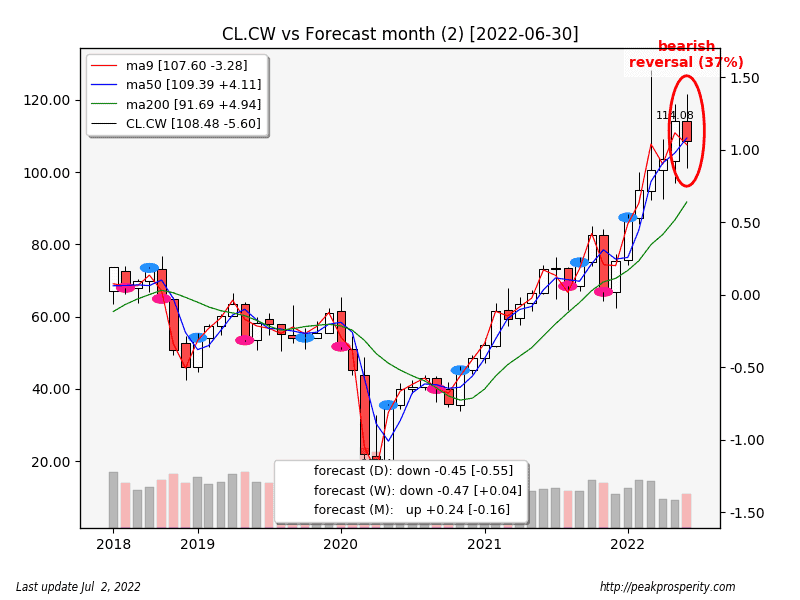
If the price of crude [down -5.60 to 108.48] is “The New Fed Funds Rate”, crude remains in a “tightening” uptrend. Sure, we see a reversal candle this month, but not a very strong one. Will crude keep rising due to peak oil, and the calculated stupidity of President Grandpa’s WEF-trained reserve-draining Handlers? Shortages will be the driver for oil prices, rather than money printing or rates. I suspect it will take massive “demand destruction” to drag crude oil prices back down to earth. Who knows though. We might see that, given time.

Note: in February, prior to the Grand Price Hike from Russia, crude was roughly $90-100, and it closed this month at $108.

Here’s more on “oil shortages”: a combo chart that merges both the Strategic Petroleum Reserve (SPR), and the commercial U.S. oil stocks. The pair are down roughly 20% from early 2021 (1.14 down to 0.913). The rate of decline in oil in storage appears to be accelerating; almost 10 million barrels this week alone.

Note too that the plunge in crude oil stocks started in 2021, long before “the Putin Price Hike” happened in March 2022. I think: the storage-drain is an in-kind campaign contribution, made by the Biden-Handlers for the benefit of their figurehead, paid for by You and Me, using the SPR.

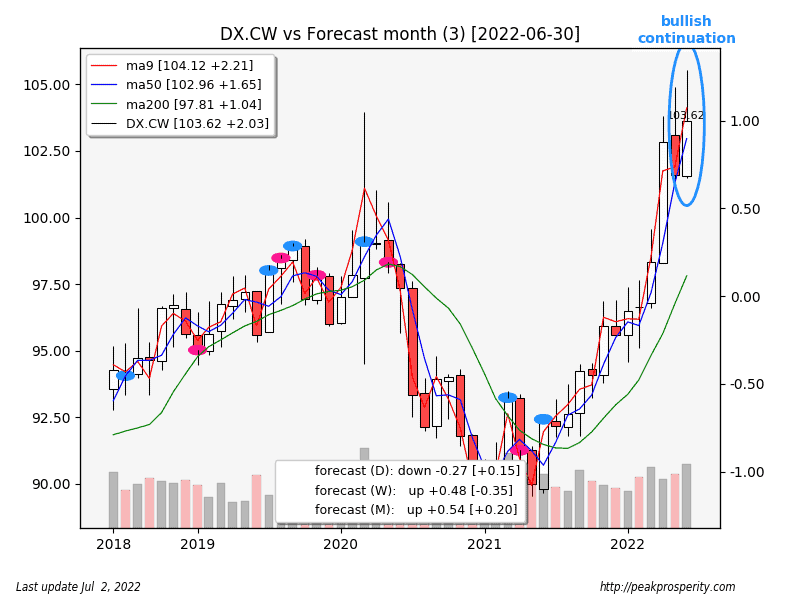
Here’s a slightly-outdated (last tick: 6/27) USD monthly chart. A rising dollar is risk-off and/or suggests contraction. How much of this is money fleeing Europe? Probably quite a bit. Poor Germany, 55% of its natural gas supply comes from Mister Price Hike. Half of the DX (U.S. Dollar) rally came in the last four months – we can probably give Putin (and/or the “strategy” by NATO, and the G7) all the credit for the dollar rally. To add to this: Winter is Coming.

And then there is Doctor Copper. Down -0.51 [-11.92%]. Ouch. About half the time Copper gets it wrong, but it is hinting that we have a recession in the offing, if not here already. Although, it could also just be something China-specific.  [Construction, Evergrande bankruptcy, etc]. Copper shows things were inflationary right up until March.

The CRB (commodity research bureau) index is a commodity price index referenced by Ed Dowd. Ed believes that commodity prices may have topped out, which is also projecting recession. The CRB chart is showing a technical trend reversal. This week it closed below the previous low set in early May. Is CRB predictive? I don’t know. I don’t have the CRB series locally, so I can’t chart it against U.S. recessions to see.

https://tradingeconomics.com/commodity/crb

And here’s the UN’s Food and Agriculture Organization (FAO) food price index, which seems to be (very roughly) tracking the CRB. It is no longer screaming higher. Has it too topped out? Maybe. The fertilizer-scarcity-driven “global starvation event” (more evidence coming in September/October) has yet to play out. Something to watch.

https://www.fao.org/worldfoodsituation/foodpricesindex/en

Gold fell -10.55 to 1831.31. A modest move down. Gold remains in a downtrend, but the low levels of open interest (OI) suggest that the banksters aren’t so eager to jump in short here. More likely we’re nearer a low than a high. I know, I keep saying that, but that’s the pattern with OI: the lower the OI, the more likely we are at a low. Although we probably have to wait for the Fed to hint at reversing course before the gold reversal actually happens.

My current sense:

  • The Fed is tightening into an impending recession (as predicted by the seven-month FINRA margin debt decline). How long will the Fed really continue to tighten? Futures currently predict: November, by 150 bp. I’m guessing that will change. This is the indicator I will be watching.
  • Commodities overall (except crude) may have topped out; another impending-recession hint.
  • U.S. crude in storage is finite; 45 days of U.S. consumption. The WEF-Biden-Handlers seem very eager to drain our emergency petroleum reserves. Because “Climate Change!”  Or, “No More Superpower For You!” Or, they’re just really stupid. Or, they’re working for Xi, “10 held by H for the Big Guy.” Take your pick.
  • Any reversal by gold probably awaits that Fed policy reversal.

Economic Direction:

Spike Protein News:

Ukraine:


from Peak Prosperity https://ift.tt/etmVSsj

Friday, July 1, 2022

New! The Forward Observer Weekly Geostrategic Intelligence Summary

Chris and the Peak team proudly introduce the newest contributor for Peak Insiders, the Forward Observer geostrategic intelligence summary. Each week, Mike Shelby will share the intelligence, observations, details and foresight impacting global affairs. This week, he explains the latest moves by NATO and how China is responding.

Executive Summary:

  • NATO’s Strategic Concept identifies China as a strategic competitor.
  • NATO coordination and integration with South Korea, Japan New Zealand, and Australia.
  • Signals a new role to defend the Western order around the globe.
  • The Chinese are building a competing international order and responding to “Global NATO” with Xi’s new Global Security Initiative.

Eastern Flank

NATO officials unveiled a new Strategic Concept, which focuses on Russian deterrence and adds China as a strategic competitor. NATO uses the report to reinforce sentiment that they don’t seek military confrontation with Russia, but also don’t discount the possibility of a Russian attack on NATO countries or interests.

As a part of the new Strategic Concept of increased deterrence, NATO is mobilizing some 300,000 troops for a “high level of readiness” in order to contain Russian military activity to Ukraine. The decision will involve some heavy lifting from the United States, which has already deployed the headquarters company of the 101st Airborne Division to Europe and plans to rebase the Army’s V Corps headquarters to Poland. The new posture also includes rebasing attack aviation, Stryker units, an infantry battalion, air defense, and F-15s from interior bases in Germany and the UK to Poland, Lithuania, and Romania, among others. NATO currently describes this as its “Eastern Flank” but would be the front lines if a high-end conventional fight were to break out.


Nato map

Russia will see this as escalatory, especially as NATO’s borders are expanding to Finland and Sweden. In previous years and in another theater, U.S. military officials have warned about misperceived actions on either side in the Indo-Pacific leading to war with countries like North Korea or China. NATO’s new deterrence strategy runs the same risk. European and U.S. intelligence and military officials have described the Ukraine conflict as likely lasting for years, while one U.S. military leader said that the U.S. seeks to use future deployments to change Russia’s decision making for the next 10-20 years. The risk of an expanding conflict drastically increases over this time horizon as the West desires regime change in Russia, and Russian President Vladimir Putin wants to expand his buffer zone and reconstitute the Russian Empire. Either one will likely lead to a broader military conflict and could ignite another world war.

China

The second major development this week came as NATO identified China as a major player in the strategic environment and a potential threat to stability in the Transatlantic. Top concerns include China’s use of cyber exploitation, the development of space weapons, economic and maritime coercion, its expanding military footprint (to include the Arctic), and their “deepening partnership” with Russia to overturn the U.S.-led, Western-supported “rules-based international order.”

It’s here where NATO’s Transatlantic mission begins to blur into global security. Officials from South Korea, Japan, Australia, and New Zealand joined the NATO Summit this week, but this isn’t the first sign of increased security and defense cooperation. South Korea and Japan have been open about their desire for increased U.S. and NATO presence in the Indo-Pacific to counter expansionary China and the network of nations committed to overturning the global status quo. Japanese officials said just this week that their attendance at the NATO Summit was intended to “promote the idea that the security of Europe and the Indo-Pacific region are inseparable.” Last month, NATO defense officials were in South Korea to discuss defense cooperation and military integration.

Under the Trump administration, many criticized NATO as being obsolete – a vestigial defense organization belonging to the bygone Soviet era. The picture that’s now emerging is that NATO is no longer obsolete if its new mission is to look beyond the Transatlantic and defend the Western order around the world. Since at least 2017, U.S. defense and foreign policy wonks have openly discussed the concept of “Global NATO” – not a formal organization, but the collection of U.S. and European allies around the globe. The Defense Department’s “Integrated Deterrence” concept depends on this network of allies to deter future conflicts. That strategy has failed in Ukraine, giving U.S. and NATO officials a strong sense of urgency to ensure it doesn’t fail in the Pacific. South Korea and Japan have a great deal to lose if the Western order fails and gives way to a Chinese-led world order.

This week, Chinese Foreign Ministry spokesman Zhao Lijian accused NATO of hypocrisy for claiming to be a regional security organization while expanding security and defense ties into the Pacific. Zhao pointed to NATO member air and naval forces participating in military drills in the Indo-Pacific as proof of creeping expansion. Zhao also accused NATO of harboring Cold War mentality and driving East-West bloc confrontation.

China is noticing exactly what’s happening, but they’re far from an innocent victim – their talk of replacing the existing order drives this new twist on an old alliance. Chinese Foreign Minister Wang Yi announced back in April that “Asia’s time has come in global governance.” A week and a half later, Chinese President Xi Jinping announced a “Global Security Initiative” that would start with uniting Asian countries against Global NATO. For as much as China opposes “bloc confrontation” they are beginning to engage in it. For now, we know relatively little about China’s GSI. I’ll detail what we do know in next week’s Geostrategic Intelligence Summary (INTSUM).


from Peak Prosperity https://ift.tt/3VCdDgX